
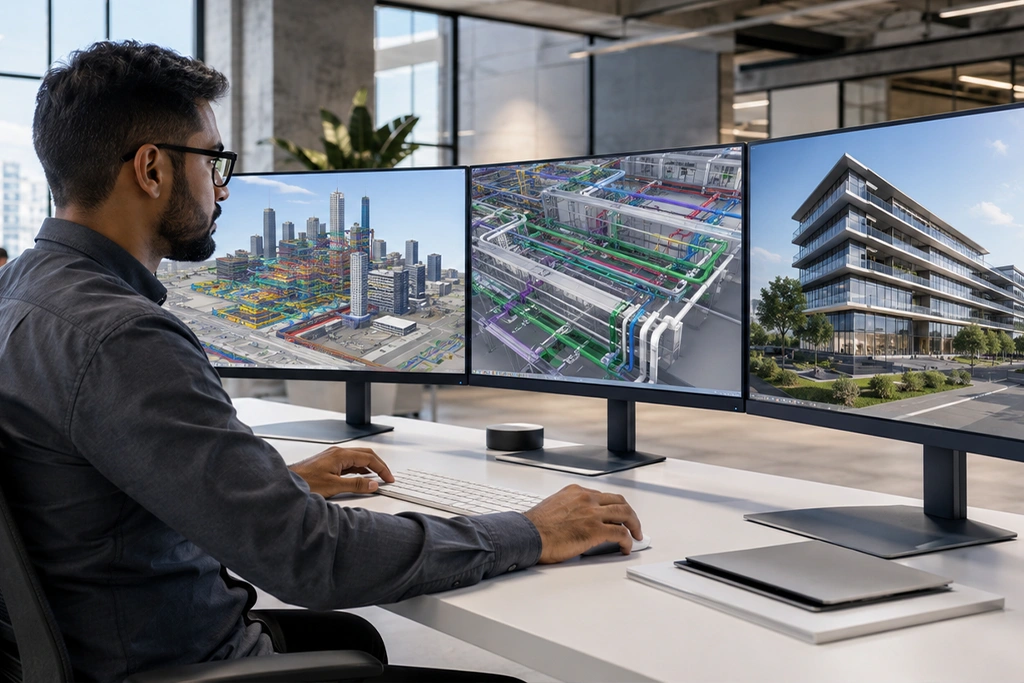
Why are construction firms across the United States investing heavily in digital project delivery? The answer lies in the growing need for accuracy, collaboration, and efficiency in an increasingly complex built environment. From commercial towers and healthcare facilities to large-scale infrastructure projects, teams are seeking smarter ways to plan, coordinate, and execute projects while minimizing costly errors.
The rise of building information modeling has become a major driver behind this transformation. According to Grand View Research, North America held a significant share of the global BIM market in recent years, with the industry projected to continue expanding steadily through the next decade as digital adoption accelerates across the architecture, engineering, and construction sectors.
As project expectations evolve, solutions from Genesis Infoserve help organizations use advanced modeling and digital workflows to improve decision-making, streamline coordination, and deliver better project outcomes. In this blog, you’ll discover why this technology is gaining momentum and what it means for the future of construction in the USA.
What Is Building Information Modeling?
It is a collaborative process that involves creating intelligent digital representations of a building’s physical and functional characteristics. Rather than relying solely on separate drawings and documents, teams work with data-rich models that centralize project information throughout the lifecycle of a facility.
These models support planning, design, construction, and even facility management by allowing stakeholders to access accurate and updated information from a shared environment.
Key capabilities include:
- Three-dimensional visualization
- Design coordination
- Quantity take-offs
- Clash detection
- Construction sequencing
- Asset information management
As projects become more sophisticated, organizations increasingly view this approach as essential rather than optional.
Why Is BIM Adoption Increasing Across The USA?
Several factors have contributed to the rapid growth of digital workflows throughout the American construction industry.
1. Growing Project Complexity
Modern projects involve multiple disciplines working simultaneously. Architects, engineers, contractors, consultants, and owners all contribute to the decision-making process.
Without integrated systems, miscommunication can result in delays, budget overruns, and design conflicts.
Using Building Information Modeling, teams can work from a unified source of information, improving visibility and reducing coordination challenges.
Benefits include:
- Improved communication
- Faster approvals
- Better documentation accuracy
- Reduced design inconsistencies
- Enhanced stakeholder alignment
2. Stronger Focus On Cost Efficiency
Construction budgets continue to face pressure from fluctuating material prices, labor shortages, and tighter timelines.
Digital planning helps identify potential issues before they become expensive field problems.
Organizations adopting these practices often benefit from:
- Reduced rework
- Improved quantity accuracy
- Better schedule control
- More predictable project outcomes
Early coordination ultimately saves both time and money.
3. Increased Government And Infrastructure Investments
Federal and state investments in transportation, healthcare, and public infrastructure have encouraged firms to embrace modern technologies.
Public agencies increasingly recognize the value of digital coordination, particularly on complex projects where efficiency and transparency are critical.
This shift has expanded opportunities for firms offering specialized BIM services to support owners, consultants, and contractors throughout project delivery.
How Does Building Information Modeling Improve Collaboration?
Construction success depends heavily on effective communication between stakeholders.
One of the biggest strengths of BIM is its ability to connect teams through shared project information.
Instead of working from isolated documents, stakeholders collaborate using coordinated digital environments.
This improves:
- Information consistency
- Version control
- Accountability
- Decision-making speed
- Multidisciplinary coordination
Cloud-based platforms further strengthen collaboration by enabling real-time access to project updates regardless of location.
The Growing Importance Of BIM Construction
Digital transformation is also changing how projects move from design to execution.
These construction practices allow contractors to identify constructability concerns early, optimize sequencing strategies, and improve site coordination before work begins.
Advantages include:
- Better trade coordination
- Improved installation planning
- Reduced field clashes
- Enhanced schedule visualization
- Increased confidence during execution
Rather than reacting to problems on-site, project teams can proactively address challenges during preconstruction stages.
Industries Leading BIM Adoption In The USA
While adoption was once concentrated among large commercial projects, its use has expanded significantly across multiple sectors.
Healthcare
Hospitals require extensive coordination among structural, mechanical, electrical, and medical systems. Digital workflows support accuracy and operational planning.
Infrastructure
Transportation projects, airports, rail systems, and utility developments increasingly rely on intelligent project delivery methods to manage complexity.
Education
Schools and universities use coordinated models to support design reviews, lifecycle planning, and future maintenance strategies.
Commercial Real Estate
Office developments and mixed-use spaces benefit from streamlined coordination and improved project transparency.
Industrial Facilities
Manufacturing and logistics facilities leverage BIM construction approaches to support efficient execution and minimize disruptions during development.
Why BIM Modeling Is Becoming A Competitive Advantage
Today’s clients expect more than completed buildings. They expect efficiency, transparency, and fewer surprises throughout the process.
This is where BIM modeling creates a distinct advantage.
By enabling teams to visualize projects before construction starts, BIM modeling supports informed decisions and improves confidence among stakeholders.
Firms that embrace these capabilities often strengthen their reputation by delivering projects with greater predictability and coordination.
Traditional Construction vs BIM-Driven Delivery
The shift toward digital workflows is transforming how projects are planned and executed. The table below highlights why many firms are embracing technology-led approaches.
| Project Aspect | Traditional Approach | BIM-Driven Approach |
| Information Sharing | Multiple disconnected files | Centralized digital information |
| Design Coordination | Manual reviews | Real-time model coordination |
| Clash Detection | Identified during construction | Detected during design stages |
| Documentation Updates | Time-consuming revisions | Synchronized updates |
| Cost Predictability | Reactive budgeting | Better forecasting |
| Team Collaboration | Fragmented communication | Improved stakeholder alignment |
| Project Efficiency | Higher chances of rework | Enhanced productivity |
These advantages explain why BIM continues to gain traction across the American AEC industry.
Challenges Firms Face During Implementation
Despite its benefits, successful adoption requires planning and organizational commitment.
Some common implementation challenges include:
- Resistance to changing established workflows
- Training requirements for internal teams
- Initial technology investments
- Standardizing processes across departments
- Managing large volumes of project data
However, companies that overcome these hurdles often report stronger collaboration, better project visibility, and improved long-term efficiency.
Many organizations partner with external providers offering BIM services to accelerate adoption while reducing the burden on internal resources.
The Future Of Building Information Modeling In The USA
The future of building information modeling extends far beyond three-dimensional visualization.
Emerging innovations are reshaping how projects are delivered, including:
- Cloud-based collaboration platforms
- Artificial intelligence for predictive insights
- Digital twins for lifecycle management
- Sustainability and energy performance analysis
- Advanced project simulations
As these technologies mature, BIM will continue evolving into a strategic asset that supports smarter decision-making throughout the asset lifecycle.
Industry forecasts suggest sustained market expansion driven by infrastructure investments and increasing digital maturity across the construction sector. Grand View Research reported that North America remained the largest regional market, supported by early technology adoption and expanding applications beyond design into operations and facility management.
How Genesis Infoserve Supports Digital Project Success
Adopting new technologies is most effective when supported by experienced professionals who understand both technical requirements and practical project challenges.
Our focus is on helping clients improve project outcomes through collaborative workflows, quality-focused delivery, and efficient coordination processes. By aligning digital practices with project goals, teams can reduce risks while enhancing communication and productivity.
Whether supporting design development or multidisciplinary coordination, they provide expertise that helps organizations maximize the value of their digital transformation initiatives.
Summary
The increasing adoption of Building Information Modeling reflects a fundamental shift in how the U.S. construction industry approaches project delivery. Organizations are seeking greater efficiency, stronger collaboration, and more predictable outcomes in an environment where complexity continues to grow.
From improving coordination to enhancing decision-making, digital workflows are helping stakeholders work smarter throughout every phase of a project. As adoption expands and technologies evolve, Genesis Infoserve supports businesses with advanced BIM solutions that help improve project coordination, streamline workflows, and deliver greater value.
Investing in innovation today is no longer just about keeping pace with industry trends. It is about building a stronger foundation for future success.
FAQs:
1. Why is building information modeling becoming more popular in the USA?
Growing project complexity, increased infrastructure investment, and the need for improved collaboration are driving widespread adoption of building information modeling.
2. How does BIM modeling improve project outcomes?
BIM modeling enhances coordination, supports early problem detection, improves communication, and helps reduce costly rework.
3. Are BIM services suitable for smaller firms?
Yes. Professional BIM services can help businesses of all sizes access specialized expertise without maintaining large in-house teams.
4. What industries benefit most from building information modeling?
Healthcare, infrastructure, education, commercial real estate, and industrial sectors increasingly rely on digital workflows to improve project delivery.
5. What is the future of building information modeling?
Future developments include AI integration, cloud collaboration, digital twins, and enhanced lifecycle management capabilities that support smarter project decisions.